 Peptide Log
· 3 min read
Injection site rotation: how to rotate and keep track of your sites
Why rotating injection sites matters, a simple pattern for rotating within and between areas, and an easy way to remember where you injected last.
If you inject on a regular schedule, the same small patch of skin can end up taking most of your injections without you noticing. Rotating injection sites is one of the simplest habits in injection-technique guidance, and also one of the easiest to let slip.
This guide covers why rotation matters, a pattern that is easy to follow, and how to remember where you injected last.
Why rotating injection sites matters
Repeated injections into the same spot can cause lipohypertrophy: a thickened, rubbery lump of fatty tissue under the skin. It has been studied most in people who inject insulin, and diabetes education guides describe two problems with it. The lumps can look and feel uncomfortable, and medicine injected into them is absorbed less predictably.
Reusing the same site is the main risk factor. Spreading injections out gives each patch of skin time to recover.
Where subcutaneous injections usually go
Injections under the skin (subcutaneous injections) are usually given into areas with a layer of fatty tissue. Patient guides commonly list:
- the abdomen
- the front or outer thighs
- the back of the upper arms
- the buttocks
Check which of these your medicine's leaflet allows. On the abdomen, stay clear of the belly button: one NHS trust advises not injecting within 5 cm (about 2 inches) of the navel. Avoid scars, and skin that is bruised, red, swollen, hard or tender.
A simple rotation pattern
A pattern you repeat is easier to keep than picking a spot each time.
- Divide each area into sections. For the abdomen, left and right of the belly button, upper and lower, gives you four sections.
- Move to the next section in a fixed order, for example clockwise around the abdomen, before you come back to the first one.
- Within a section, space injections out. Injection-technique guides recommend keeping each injection at least 1 cm, about a finger's width, from the previous one.
- Look and feel before you inject. If the skin feels lumpy, firm or different, choose another spot and mention it to your clinician.
Rotating in a planned way works better than choosing at random. A diabetes education guide notes that systematic rotation greatly reduces lipohypertrophy compared with random site choice.
The hard part: remembering
A pattern only works if you know where you are in it. After a few weeks, memory is unreliable, especially with weekly injections, where the last site was seven days ago.
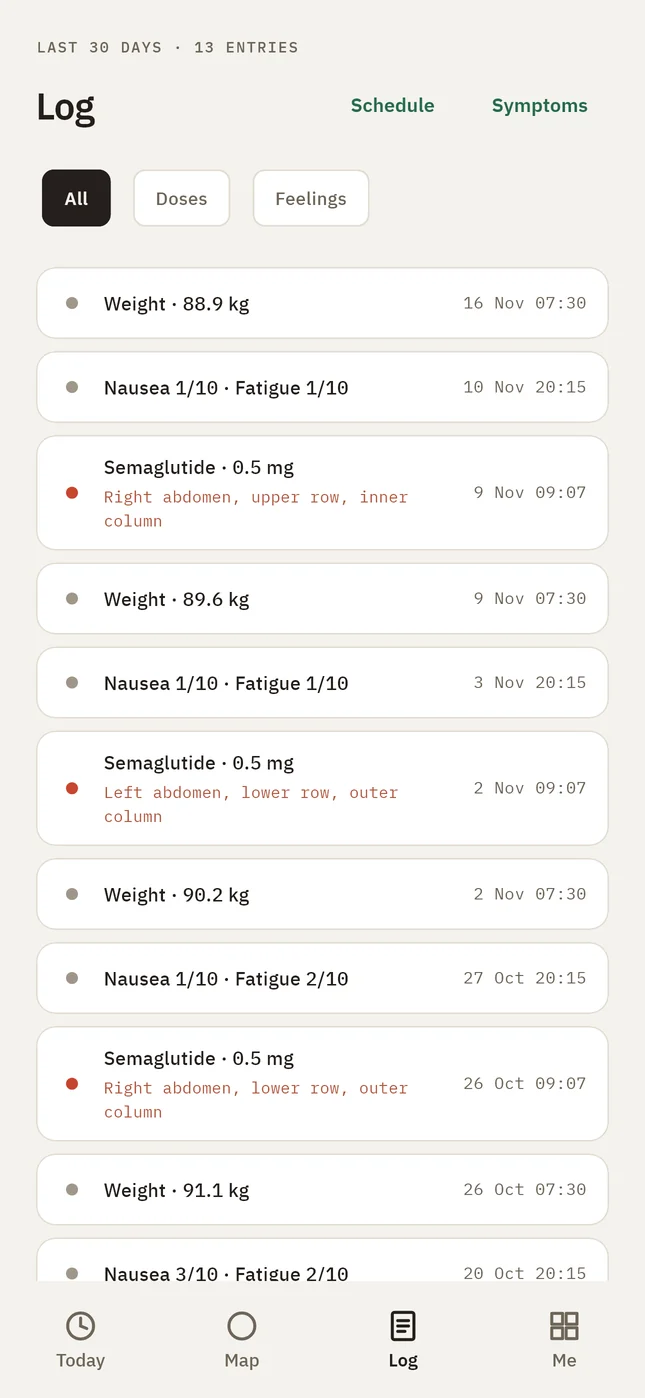
Writing down the site with every injection solves this. A useful entry names the area and the section, such as "abdomen, lower left", next to the date and time. Before your next injection, a glance at the last few entries tells you where to go next and which spots have rested longest.
For more on what to note alongside the site, see what to write in an injection log.
How Peptide Log helps
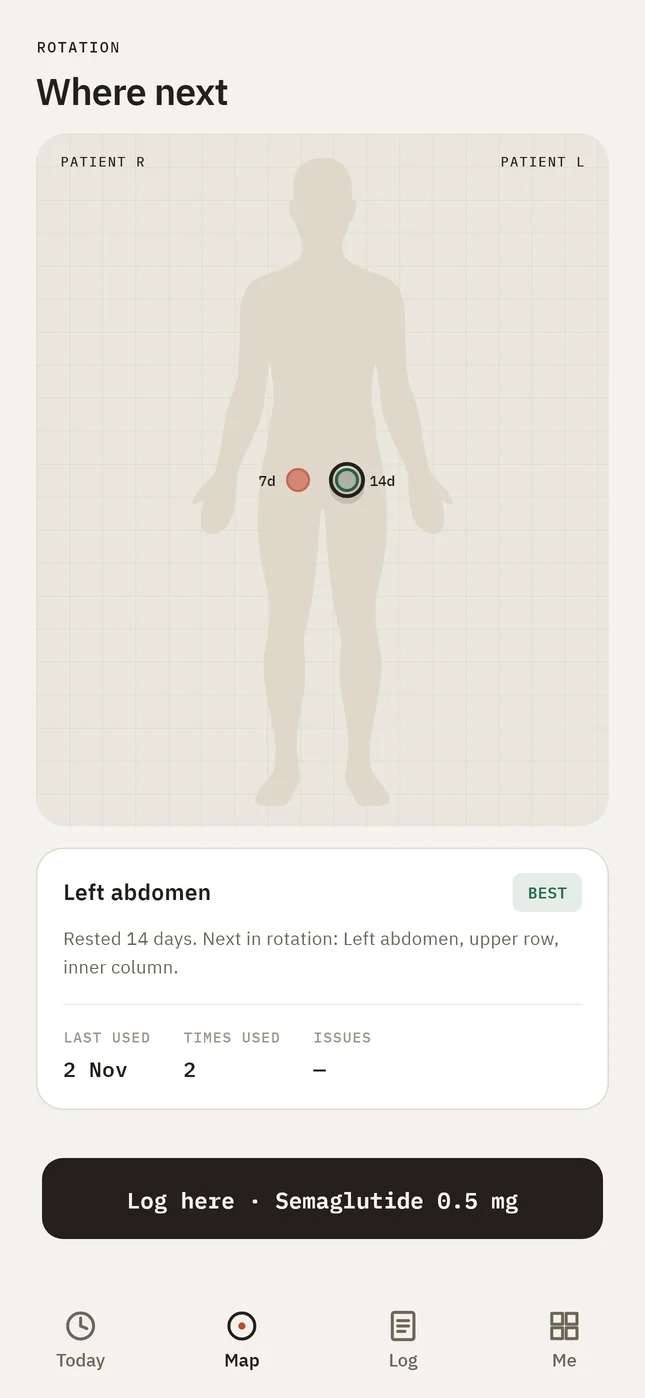
Peptide Log records the site with every injection and shows it on a body map, with how long ago each area was used. On the abdomen you can pick one of twelve spots, each showing its days since use; the spots right around the navel cannot be selected. You set a minimum rest period, and the app suggests a rested site from the spots you have logged. It records what you log; the choice of site, and every instruction from your leaflet and clinician, stays yours.
Sources
- How to: Injection technique, Diabetes on the Net, 2022
- Insulin injection sites and insulin storage, The Royal Children's Hospital Melbourne
- Subcutaneous injection self-administration, South Tees Hospitals NHS Foundation Trust
General information
This article is general information to help you keep good records. It is not medical advice and does not replace your prescriber, your pharmacist or the leaflet that comes with your medicine. If something feels wrong in your body, contact a clinician. In an emergency, call your local emergency number.