 Peptide Log
· 3 min read
Keeping track of your vials: dates, amounts and what is left
What to write down when you open or prepare a vial, how to keep an eye on what is left, and the label details that decide when a vial should be thrown away.
Two things tend to go wrong with vials: running out sooner than expected, and using one after it should have been thrown away. Both are easier to avoid with a few notes made when the vial is first opened.
Write it down when you open or prepare a vial
When you start a new vial, note:
- The date you opened it, or the date you prepared it if it needed mixing.
- The amount in the vial, exactly as printed on the label, with its unit.
- If you added liquid, what you added and how much, exactly as your instructions say.
- The lot number and the expiry date printed on the vial or box.
- The discard-by date, worked out from the label or leaflet (see below).
Writing the discard-by date on the vial itself, as well as in your log, means you see it every time you pick the vial up.
How long an opened vial lasts
The label and the leaflet decide this, and products differ. Do not assume that the expiry date printed on the box still applies once the vial has been opened.
For comparison, US guidance for healthcare settings, cited by the Centers for Disease Control and Prevention from the United States Pharmacopeia, says an opened multi-dose vial should be dated and thrown away within 28 days unless the manufacturer gives a different date. The same guidance says to discard a vial whenever its sterility is in doubt, whatever the date.
Store it as the label says
Follow the storage instructions on the label: the temperature range, whether to keep it in the fridge, whether to protect it from light, and whether it must not be frozen. If a vial has been stored outside those conditions, ask your pharmacist before using it.
Keep an eye on what is left
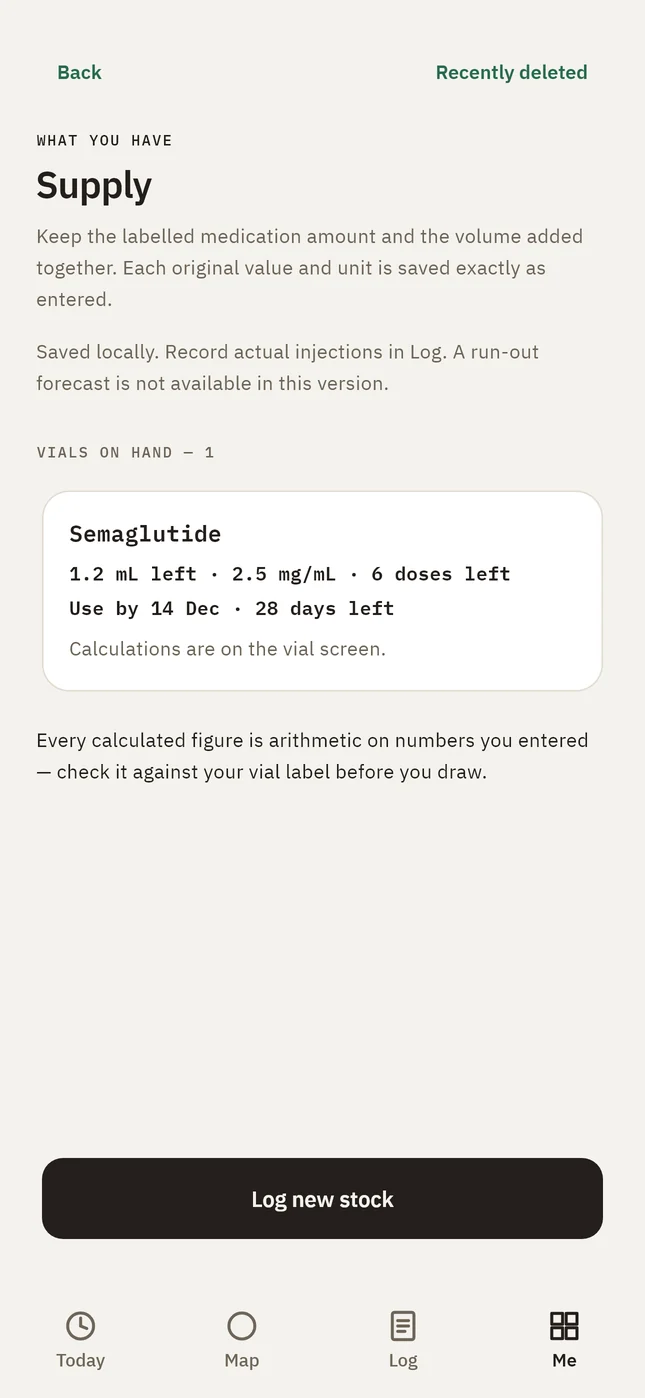
Each dose you draw reduces what is left. Subtracting each logged dose from the starting amount shows roughly how much remains and how many doses that covers, so you can arrange the next vial before you need it.
Treat that number as a planning aid. It is arithmetic on the figures you wrote down, so a mistake in any of them carries through. Check it against the vial and your instructions, and never use it to change a dose.
Dispose of needles safely
The US Food and Drug Administration recommends putting used needles and syringes straight into an FDA-cleared sharps disposal container. If you do not have one, a heavy-duty plastic household container with a tight, puncture-resistant lid can be used instead. Replace the container when it is about three-quarters full, keep it out of reach of children and pets, and never put loose needles in household rubbish or recycling. Local rules for disposing of a full container vary, so check what applies where you live.
How Peptide Log helps
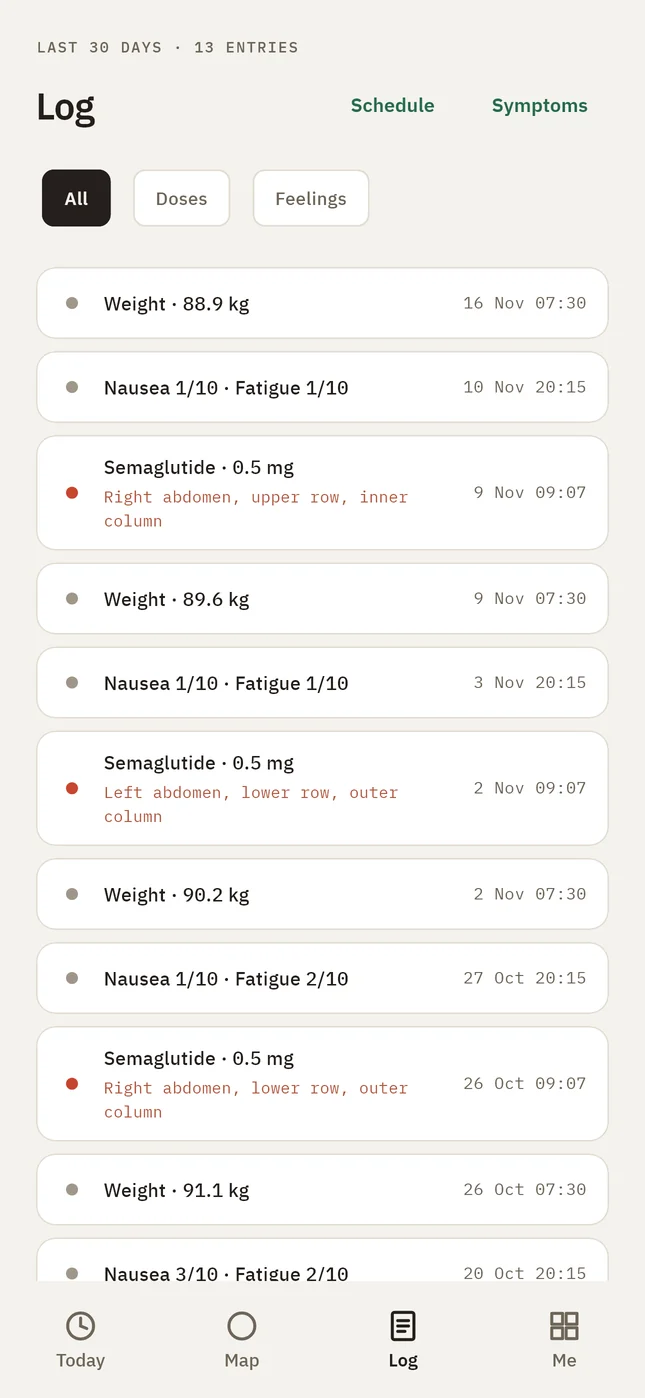
Peptide Log keeps a record for each vial: what it contains, what you added and when. As you log injections from it, the app shows what is left, and every figure shows the arithmetic behind it so you can check it against your label. See also what to write in an injection log.
Sources
- Preventing Unsafe Injection Practices, Centers for Disease Control and Prevention
- Sharps Disposal Containers, US Food and Drug Administration
- Safely Using Sharps (Needles and Syringes) at Home, at Work and on Travel, US Food and Drug Administration
General information
This article is general information to help you keep good records. It is not medical advice and does not replace your prescriber, your pharmacist or the leaflet that comes with your medicine. If something feels wrong in your body, contact a clinician. In an emergency, call your local emergency number.