 Peptide Log
· 3 min read
Staying on a weekly injection schedule: habits that help
Practical ways to remember a once-a-week injection, what to write down when a dose is late, and why a written record beats memory.
A weekly injection is easy to forget precisely because it is weekly. A daily medicine becomes part of the morning; a weekly one has six days in between to slip out of mind. And when you are not sure whether you took it, guessing either way is a problem.
Taking medicines as prescribed over the long term is hard for many people. A 2003 World Health Organization report estimated that adherence to long-term therapies for chronic conditions averages around 50 percent in developed countries. That figure is a rough synthesis of very different studies and has been questioned since, but the point stands: missed and mistimed doses are common, and they are rarely about willpower.
These habits help.
Pick an anchor day and time
Choose a day and time that is usually the same from week to week, and tie it to something that already happens every week, such as Sunday evening or the evening before a regular commitment. Avoid days that are often disrupted.
Set two reminders
One reminder tells you the injection is due. A second, the next morning, asks a different question: did it happen? A calendar entry or a phone alarm works for both.
Log it immediately
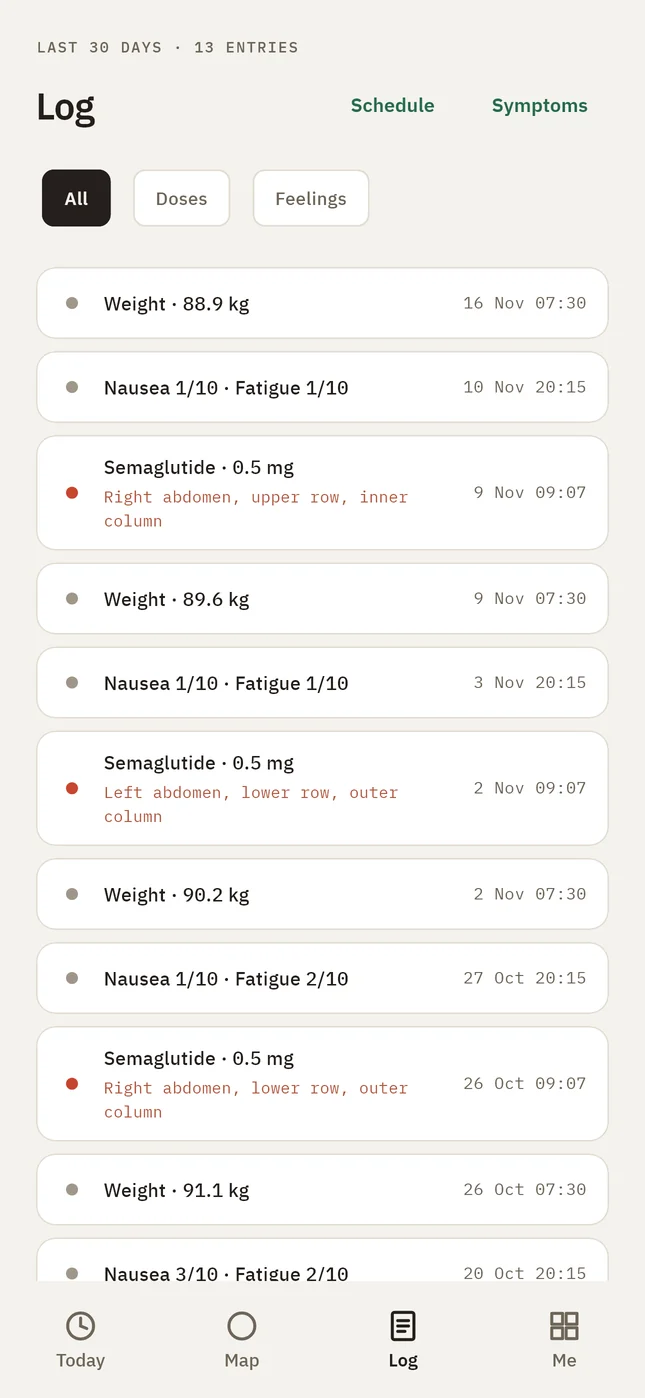
A reminder tells you a dose is due; only a record tells you it is done. Write it down straight after the injection, with the time and the site. The next time you wonder whether you took it, you can check instead of guessing.
See what to write in an injection log for the details worth noting.
When a dose is late or missed
Rules for late doses differ from one medicine to another. Some allow a late dose within a set number of days; others say to skip it and carry on with the next one. The leaflet that comes with your medicine says what to do, and your pharmacist can help if it is unclear.
Whatever you do, write down what actually happened: the real date and time of the dose, or that it was skipped. A log that shows the gaps is far more useful to you and your clinician than one that looks perfect.
Travelling
- Keep your supplies with you, and follow the storage instructions on the label while you travel.
- Take a small, travel-size sharps container. The US Food and Drug Administration advises always carrying one in case other disposal options are not available.
- If you cross time zones, ask your clinician or pharmacist how to time the next dose, and log the actual time you take it.
How Peptide Log helps
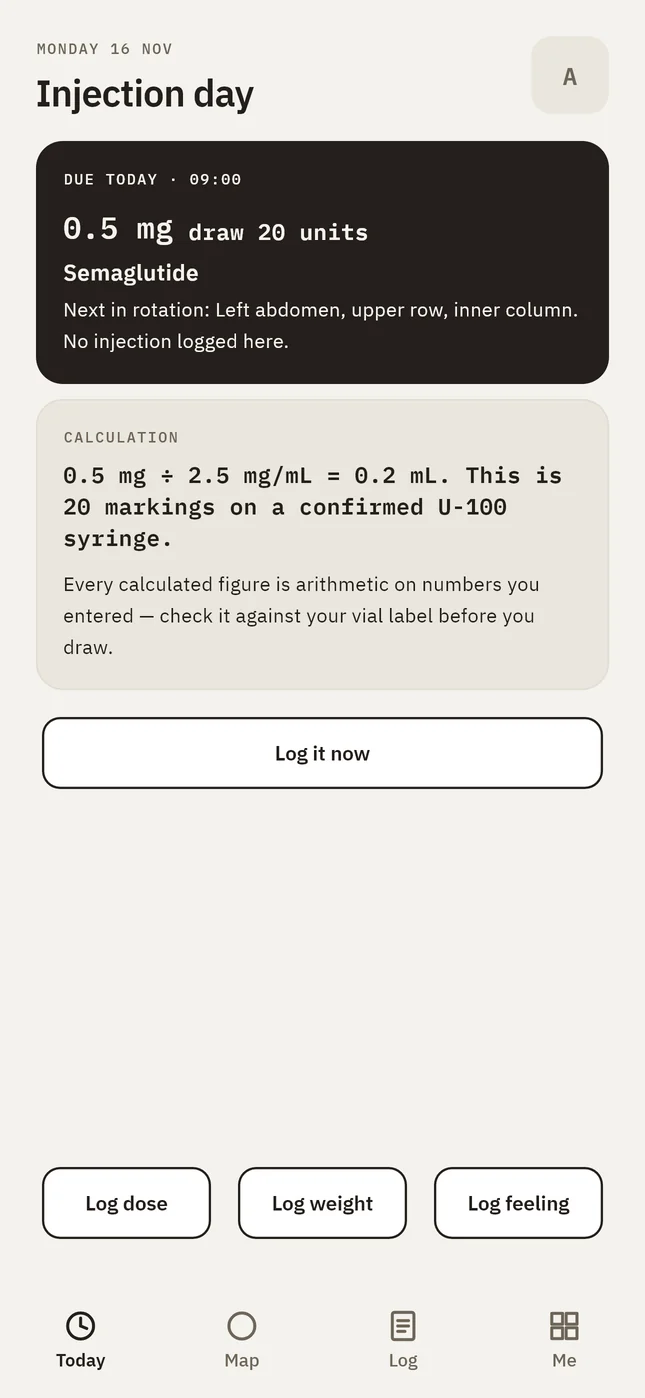
Peptide Log's Today screen shows your next planned dose and the suggested site, and logging it takes a tap or two from there. Every entry is kept with its date and time, so "did I take it?" has an answer. The plan follows the schedule you entered; the app does not change a dose or a schedule on its own.
Sources
- Failure to take prescribed medicine for chronic diseases is a massive, world-wide problem, World Health Organization, 2003
- PMC3525884, PubMed Central, 2013: a paper tracing the sources behind the 50 percent figure
- Safely Using Sharps (Needles and Syringes) at Home, at Work and on Travel, US Food and Drug Administration
General information
This article is general information to help you keep good records. It is not medical advice and does not replace your prescriber, your pharmacist or the leaflet that comes with your medicine. If something feels wrong in your body, contact a clinician. In an emergency, call your local emergency number.